
- Most networked AV equipment can be monitored remotely today: projectors, displays, DSPs, control processors, cameras and switches already report their state over PJLink, SNMP, vendor control protocols or a cloud.
- There are three ways to connect: vendor clouds, a small on-site monitoring box, and generic network monitoring. Only the on-site box reaches AV gear with no cloud account, which in most estates is the majority.
- Monitor what users experience, not just reachability: power and input state, lamp and error flags, temperatures, DSP health and the network path underneath.
- Remote monitoring pays off when every alert that matters becomes a ticket against the right asset and most faults are fixed from a desk with an audited command.
Short answer: yes. Most AV equipment installed in the last decade (projectors, flat panels, DSPs, control processors, cameras, video conferencing codecs and the switches they hang off) can be monitored remotely today, usually without touching the devices at all. What it takes is a network connection, a protocol the device already speaks, and something that can reach it: either the manufacturer's cloud or a small monitoring box on the same network.
This guide explains how networked AV monitoring works, the three ways to connect, exactly what to check on each type of device, how alerts should turn into fixes, what your IT security team will ask, and a four-week plan to get your first site monitored.
Can AV devices be monitored remotely?
A device can be monitored remotely if three things are true:
- It is on a network. Anything with an Ethernet port and an IP address is a candidate. Devices connected only by RS-232, IR or analogue audio can't be polled directly.
- It speaks a control or status protocol. Projectors and many displays speak PJLink; switches, many displays and a lot of AV infrastructure answer SNMP; Q-SYS cores speak QRC; Crestron and AMX processors speak their own control protocols; cameras speak ONVIF; newer devices publish an HTTP API or accept SSH.
- Something can reach it. Either the manufacturer runs a cloud service the device reports into, or a monitoring box sits on the same network and polls it.
Equipment that fails the first test isn't a lost cause. A projector driven over RS-232 by a control processor can often be watched through that processor, if the programming exposes its state. And anything genuinely unmonitorable (a passive speaker, a wall plate) is covered by QR fault reporting and a scheduled AV system health check.
How networked AV monitoring works
Every remote monitoring system, whatever the brand, runs the same loop:
- Find the AV devices on each site network and match them to rooms and asset records.
- Poll each device on a schedule over the protocol it speaks, and listen for anything it reports by itself.
- Compare what comes back with what is expected: the device answered, it is powered, it is on the right input, no error flag is raised, readings are within limits.
- Alert when something changes (once, not every time the check runs).
- Act: send a command to power-cycle, switch input, mute or reboot, or raise a ticket for someone to attend.
- Record the event, the action and the result against the device, so the history accumulates.
The difference between tools is where that loop runs and how much of the estate it can reach, which is what the three connection methods below are about.
Three ways to monitor AV remotely
| Method | What it reaches | Strengths | Blind spots |
|---|---|---|---|
| Vendor clouds (Q-SYS Reflect, Crestron XiO Cloud, Teams Rooms, Zoom Rooms, Webex Control Hub, Logitech Sync, Poly Lens) | That manufacturer's devices, once enrolled | Deep device detail, firmware and configuration for their own brand | Every other brand in the room, and gear with no cloud account at all |
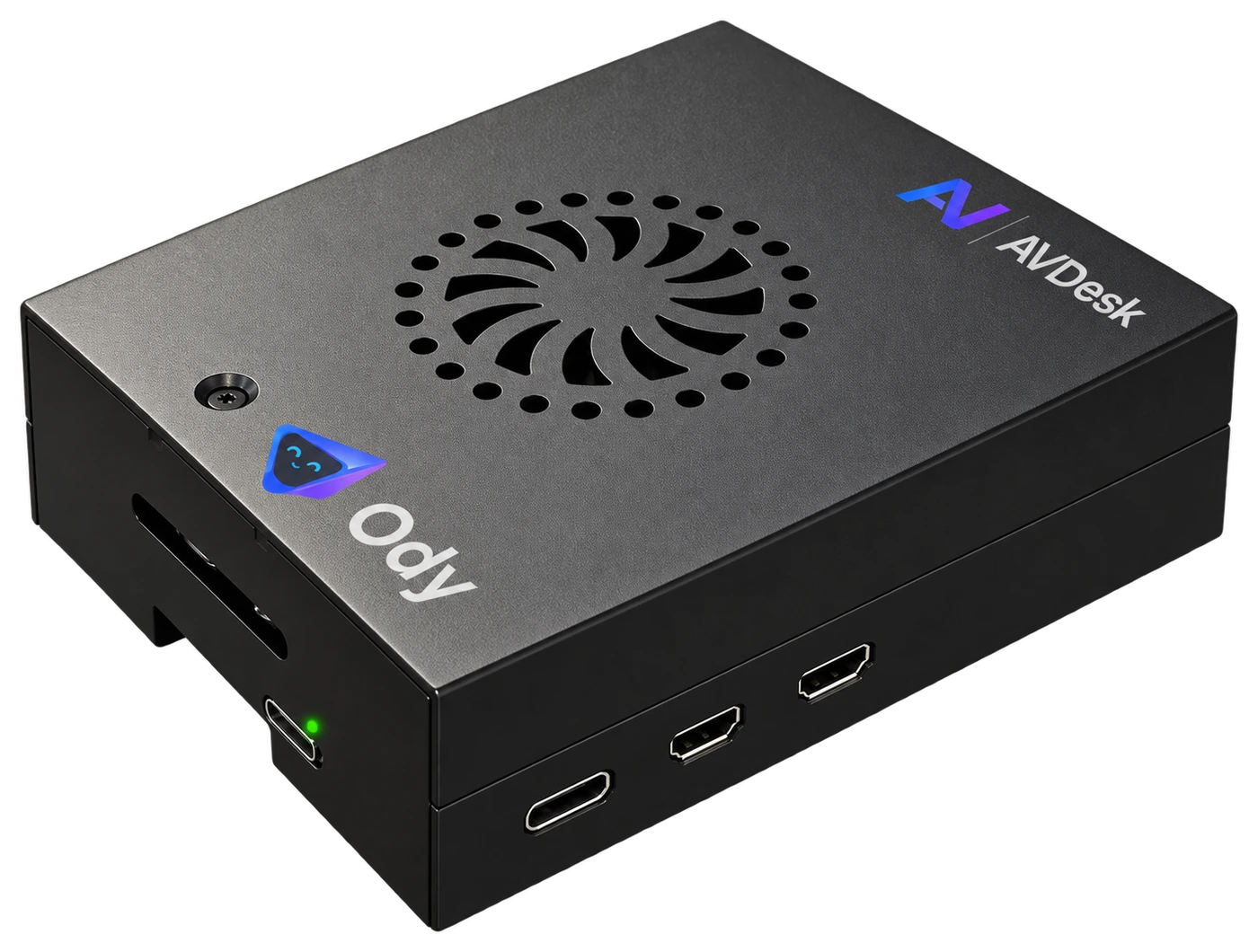
| On-site monitoring box (in AVDesk, Ody) | AV equipment on the site network, across brands, over the protocols it already speaks | Reaches projectors, displays, DSPs, processors and switches that have no cloud; wakeup checks; remote control | Needs a small box installed on each site's AV network |
| Generic network monitoring (IT's ping and SNMP tools) | Anything with an IP address | Already owned by IT; good for switches and uplinks | No idea what a room is, what a lamp error means or who should fix it |
Real estates are never one brand, so the answer is rarely one method. The practical pattern is an on-site box at each site for the long tail of AV equipment, with vendor clouds federated in for the rooms that have them (the approach set out in AVDesk vs vendor-specific cloud monitoring).
What "cloud-based AV monitoring" actually means
Almost every modern platform is cloud-based: the dashboard, alerting, history and reporting run in the cloud so the team can work from anywhere. What matters is how the cloud gets its data. A vendor cloud only hears from devices that phone home to it. A cloud platform with an on-site box hears about the AV equipment the box manages on the local network. When a product is described as cloud-based AV monitoring, ask which of the two it is.
What to monitor on each type of AV device
"Is it pinging?" is the weakest check there is. A projector can answer on the network while showing a lamp error to a room full of people. Monitor the state users actually experience:
| Device | What to watch | Usually read over |
|---|---|---|
| Projectors | Power, input, lamp or light-source hours, filter hours, fan, temperature and cover errors | PJLink, SNMP, vendor protocol |
| Flat panels and LED walls | Power, input, temperature, error state | PJLink, SNMP, vendor IP control, HTTP |
| DSPs and audio cores | Online, design running, component and channel faults | Q-SYS QRC, SNMP, vendor protocol |
| Control processors and touch panels | Processor online, program running, panels connected | Crestron, AMX NetLinx |
| Cameras | Reachable, streaming, correct preset | ONVIF, HTTP |
| Video conferencing rooms | Room health, peripherals connected, sign-in state | Vendor cloud via SSO |
| Network switches | Uplinks, port state, PoE budget | SNMP |
Two checks deserve special mention. Network infrastructure, because a surprising share of "AV faults" are a dead switch port or an exhausted PoE budget. And projectors and displays, because they are the device users judge the room by. They have their own guide in remote monitoring for projectors and displays.
AV monitoring and diagnostics: from alert to fix
An alert is only useful if it leads somewhere. A good remote monitoring setup does four things with each one:
- Suppresses noise. A device that drops for ten seconds and recovers shouldn't page anyone. Recovery should have to hold before an alert closes, and a device that keeps bouncing should reopen the same issue rather than create twenty new ones.
- Becomes a ticket. Alerts that matter become a ticket against the device, with the site, room and asset history attached and an SLA clock running, so nothing depends on someone watching a screen.
- Offers a remote fix. Power-cycle the display, switch the input, mute or un-mute, recall a preset or reboot the processor from the same screen that raised the alert. Most day-one faults end there.
- Leaves a trail. Every command is recorded against the device and the person, so "who did what, when" always has an answer, and the diagnostic history is there the next time the room misbehaves.
Diagnostics improve with time. When every event lands on the same asset record, patterns show up (the room whose display drops every Monday, the model whose lamps die early), and you fix the cause instead of the symptom.
Wakeup checks: monitoring before the room fills
The rooms that matter most are often idle overnight, so a fault that starts at 2am is invisible until 8:59. A wakeup check verifies nominated rooms before the day starts: the projector answers, the display is reachable, the DSP is running, the processor is online. Anything that fails raises a ticket while there is still time to fix it: the boardroom before the board, the lecture theatre before the first lecture.
Security: monitoring without opening your network
Remote monitoring should never mean opening your network to the internet. The model that passes a security review:
- Outbound-only. The on-site box dials out to the platform over an encrypted tunnel. No inbound firewall ports, no port forwarding, no VPN to maintain.
- Scoped. The box talks to AV equipment only. It isn't a general-purpose network scanner and it doesn't touch business systems or data.
- Nothing on the devices. Monitoring uses the protocols devices already speak, so there is no agent to install on a projector or DSP.
- Audited. Access is role-based, and every remote command is logged.
If your IT team wants the full list, it's in security questions to ask before choosing AV software.
A four-week rollout for remote AV monitoring
- Week 1: pick the rooms and install. Choose one site and name its critical rooms. An accredited integrator installs the on-site box on the AV network; in AVDesk that's Ody, which needs a network connection and power.
- Week 2: build the inventory. The AV devices Ody finds land in a validation queue; approve them into the asset register against their rooms. Connect the vendor clouds you already use through single sign-on.
- Week 3: set the rules. Decide which alerts raise tickets, who is rostered to receive them, which rooms get wakeup checks and what the response targets are.
- Week 4: measure. Count the faults detected before a user reported them, the faults fixed without a site visit, and the devices still dark. Then roll out to the next site.
Remote AV monitoring with AVDesk
AVDesk AV Management Software was built around this model. Ody, the compact on-site box, manages the AV equipment at each site over PJLink, Q-SYS QRC, Crestron, AMX NetLinx, ONVIF, SSH, SNMP and HTTP APIs and connects outbound to the AVDesk cloud; vendor clouds federate in via SSO; alerts become tickets with SLA clocks; remote commands are audited; and every event lands on the asset's history. Run it with your own team, or choose AVDesk Managed Support and have our team watch the monitoring for you. See how managed AV services work.
Monitoring is included for every room, priced per room and quoted for your estate. Explore remote AV monitoring and control, or book a demo on your own rooms.