
- AV support is five workflows about the same rooms and equipment; running them in five tools means nothing links to anything.
- AVDesk keys everything to site, room and asset, so a ticket, a task, a maintenance job and a shift all point at the same record.
- Assets, support desk, tasks, maintenance, rostering, monitoring and site documentation are modules of one platform, not integrations.
- The day starts on one dashboard: what's down, what's breaching SLA, and what's assigned to you across tickets, maintenance and tasks.
The five-tool problem
A typical AV support team, whether in-house or an integrator's service desk, runs something like this. Assets are in a spreadsheet, or a generic IT asset tool that thinks a DSP is a laptop. Tickets come in by email and live in an inbox, or in an IT service desk that has no idea what a room is. The roster is in Excel or a generic rostering app. Tasks (the lamp to order, the preset to rebuild, the pre-event check) are in a chat thread or a kanban board. Maintenance visits are calendar appointments. Monitoring, if there is any, is a vendor cloud per brand.
Every one of those tools is fine on its own. The damage is in the gaps between them. The ticket doesn't know which projector it's about. The maintenance visit doesn't know the room had four tickets this month. The roster doesn't know who's assigned the work. The asset register doesn't know the device has been power-cycled weekly since March. And the AV manager spends the first hour of every day assembling a picture from five windows.
What "one platform" has to mean
It's easy to put five modules under one login. What matters is that they share a spine. In AVDesk everything is keyed to the same hierarchy (site, building, level, room, asset), so:
- A ticket is about a room and its equipment, not just a requester.
- A task can point at a ticket, a room or an asset.
- A maintenance job is attached to a room or an asset and generates its own tickets.
- A shift is a person at a site, and that person is the same one assigned the tickets, tasks and maintenance at that site.
- A monitoring alert raises a ticket against the device, and the device's history shows the alert, the ticket and the fix.
Link from anything to anything, and history accrues in one place: against the asset.
Assets: the register everything hangs off
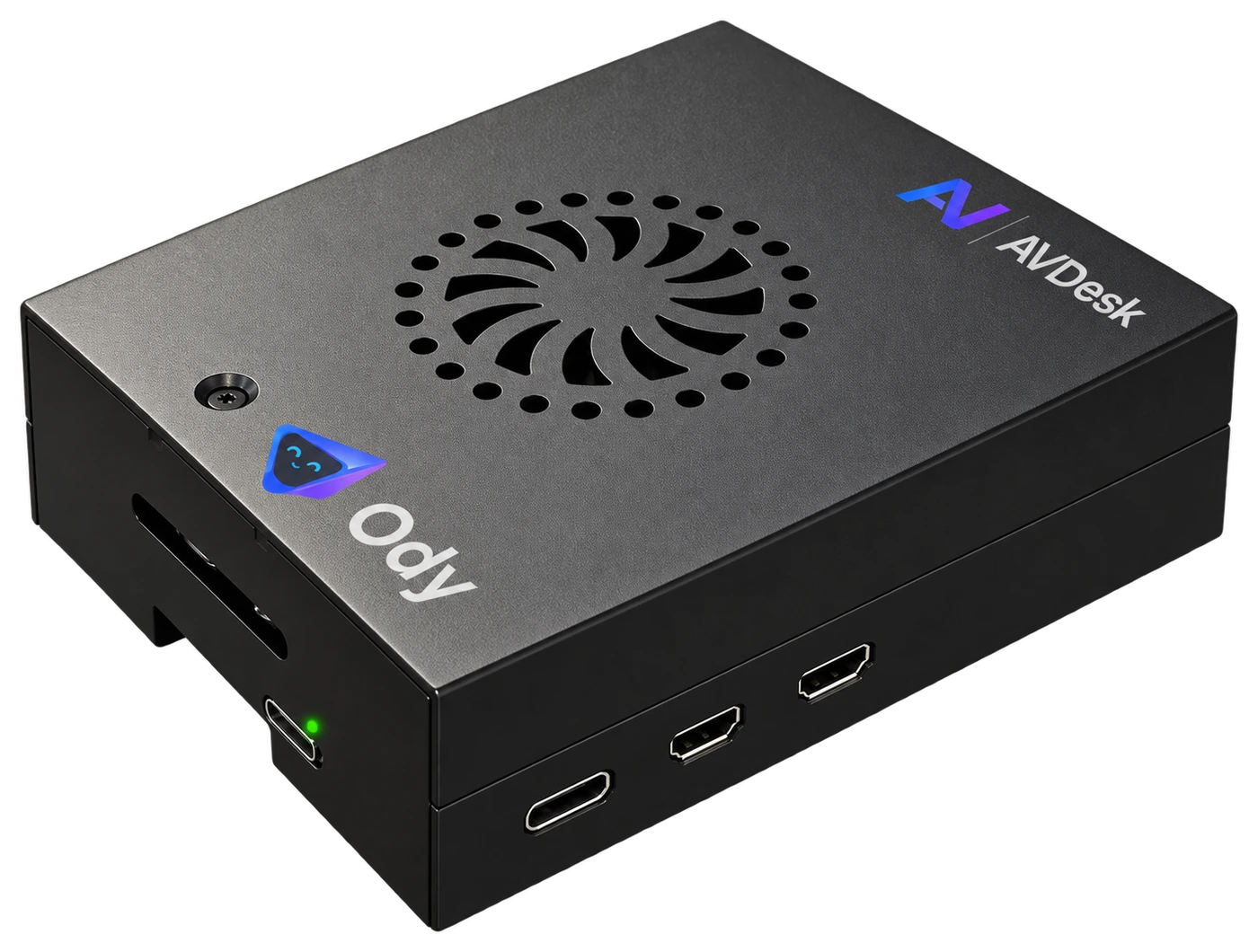
The AVDesk register is filled by discovery (the on-site Ody box finds AV devices and a validation queue approves them) and kept true by QR labels that open the record wherever the equipment is. Each asset carries cost, straight-line depreciation, written-down value, warranty, Test & Tag records, photos, notes, consumables and spares, and a field-level activity trail. Stocktakes are camera-scan sessions. Lifecycle dates on the model catalogue drive a refresh forecast by financial year. The full method is in building an AV asset register that stays accurate.
Support desk: tickets that know the room
Tickets arrive three ways: from a room QR code scanned by whoever's standing there, from email into a per-site support mailbox, and from monitoring alerts raised automatically. Every one lands linked to the room and its equipment. SLA policies run response and resolution clocks per priority; clocks pause while you wait on the requester; requesters follow progress on a public link without an account; internal notes stay internal. Tickets assigned to you sit pinned at the top, and a wallboard with audible alerts runs on the wall of the AV office. Why this beats a generic help desk is in what an AV support ticketing system should do.
Tasks: the work behind the ticket
A ticket says the projector is dim. The tasks are: order the lamp, schedule the swap, update the register, close the ticket. AVDesk's tasks are site tasks with a where (a room or an asset) and a who, with checklists whose individual items can each be assigned to a different person and ticked off from a phone. Tasks link to tickets through the ticket picker, so nothing is orphaned, and follow-ups have their own dashboard and reminder email so the lamp actually gets ordered. Details in task management for AV teams.
Maintenance works: scheduled and closed against the asset
Preventative schedules are attached to rooms and generated from their live asset list, so the quarterly theatre check covers what's actually installed. Ad-hoc works (a lamp swap, a re-termination, a firmware campaign, a contractor visit) are maintenance jobs with several assignees, a technical or administrative type, photos of the work and a calendar. Every job produces real tickets in the same SLA-tracked queue as reactive work, and closes against the asset, so the history that drives repair-or-replace decisions is complete. Read scheduling, assigning and closing maintenance works.
Rostering: the same people, on shift
Rostering is a per-site module you switch on for the sites that need it. Positions, shift templates, each person's normal week as a pattern that generates editable shifts, recurring series, drafts and publishing, open shifts that staff claim from their phones, leave and unavailability with an Australian leave taxonomy and manager approvals, clash detection, a staff-by-day grid with weekly hours, email and in-app notifications, and a printable roster. The person on shift is the person assigned the tickets. Read rostering an AV team without the spreadsheet.
Monitoring closes the loop
The on-site Ody box monitors and controls the AV equipment on the LAN over PJLink, Q-SYS QRC, Crestron, AMX NetLinx, ONVIF, SSH, SNMP and HTTP APIs, and vendor clouds federate in via SSO. Alerts raise, reopen and auto-close tickets under per-site policies, with flap suppression so a bouncing switch port doesn't spawn twenty tickets. Wakeup checks verify critical rooms before the day. Remote control (power, mute, preset recall, reboot) is issued from the ticket, through an outbound-only encrypted tunnel, with every command logged.
Site documentation, next to the equipment
Each site has a wiki: how the rooms are run, rack photos, standard presets, contractor contacts, with attachments and pictures, searchable from a phone. It sits beside live collaborative spreadsheets for the lists teams keep anyway. Knowledge stops living in one technician's head.
The dashboard that starts the day
One screen: estate uptime, open tickets, mean time to resolve, SLA compliance, maintenance ahead, and "assigned to you" lanes that pull together the tickets, maintenance jobs and tasks with your name on them, across every site you can see. Reporting rolls the same data up for leadership: uptime by site and room, SLA performance, fault hotspots, refresh exposure by financial year.
Five tools versus one
| Job | Five tools | AVDesk |
|---|---|---|
| Which projector is this ticket about? | Ask the requester, search the spreadsheet | Linked on the ticket; scan the label to confirm |
| Has this room been trouble before? | Search the inbox by room name | Room and asset history on one screen |
| Who's on shift to take it? | Open the roster file | Same platform; assign to the person rostered |
| Did the lamp get ordered? | Scroll the chat thread | Task linked to the ticket, follow-up reminder sent |
| Was the maintenance done? | Calendar says it was scheduled | Ticket closed with photos against the asset |
| What's the estate worth and what's due for refresh? | Nobody knows | Written-down value and a refresh forecast by FY |
Who runs it
AVDesk fits three operating models. In-house AV teams run it self-managed. Integrators run it for their clients as a service, with tenancy that lets them see every client estate while each client sees only its own. And organisations without an AV team choose AVDesk Managed Support, where our team watches the monitoring, works the tickets and meets the SLAs. Permissions are role-based and granular down to individual actions, per site.
The fault is found by the platform, assigned to the person on shift, fixed from the desk, followed up by a task, closed against the asset and reported to leadership, without leaving AVDesk once.
See what a day looks like in a day in the life of an AV support team on AVDesk, or book a demo and bring your five tools; we'll show you them as one.