
- Vendor clouds are deep on their own hardware and structurally blind to everyone else's. That's not a flaw, it's their design.
- AVDesk isn't a rip-and-replace: vendor clouds federate in via SSO while Ody covers the non-cloud majority.
- The estate-level jobs (one alert stream, one ticket queue, one asset history, cross-vendor reporting) only exist at the platform layer.
- Keep the vendor tools for deep device work; stop using them as your only windows.
When AV teams evaluate AVDesk, the question usually arrives as "why not just use Q-SYS Reflect / XiO Cloud / the Teams admin centre? We already have them." It's a fair question, and the honest answer starts with what those tools genuinely do well.
What vendor clouds are genuinely good at
Q-SYS Reflect knows a Q-SYS core more intimately than any third party ever will. Crestron XiO Cloud can push config and firmware across a Crestron fleet with real depth. Microsoft's Teams Rooms tooling, Zoom Rooms, Webex Control Hub, Logitech Sync, Poly Lens: each is a deep, first-party window into its own hardware. If your estate were one vendor, one of these might be most of the answer.
Where they are structurally blind
The blindness isn't a bug; it's the business model. Each vendor cloud sees exactly its own devices, and a real estate is never one vendor:
- The third-party majority (projectors, displays, switchers, amps, cameras, legacy processors) has no cloud at all and appears in none of them.
- Network infrastructure, the switch uplinks and PoE budgets behind a large share of "AV faults", is outside every AV vendor's cloud.
- The cross-vendor jobs don't exist anywhere: one alert stream, one ticket queue with SLA clocks, one asset register with cost, depreciation and lifecycle dates, uptime reporting across the whole estate.
- Each cloud is another tab, another login, another alert format, with the swivel chair as the integration layer.
What AVDesk does differently
AVDesk approaches the estate from both ends at once:
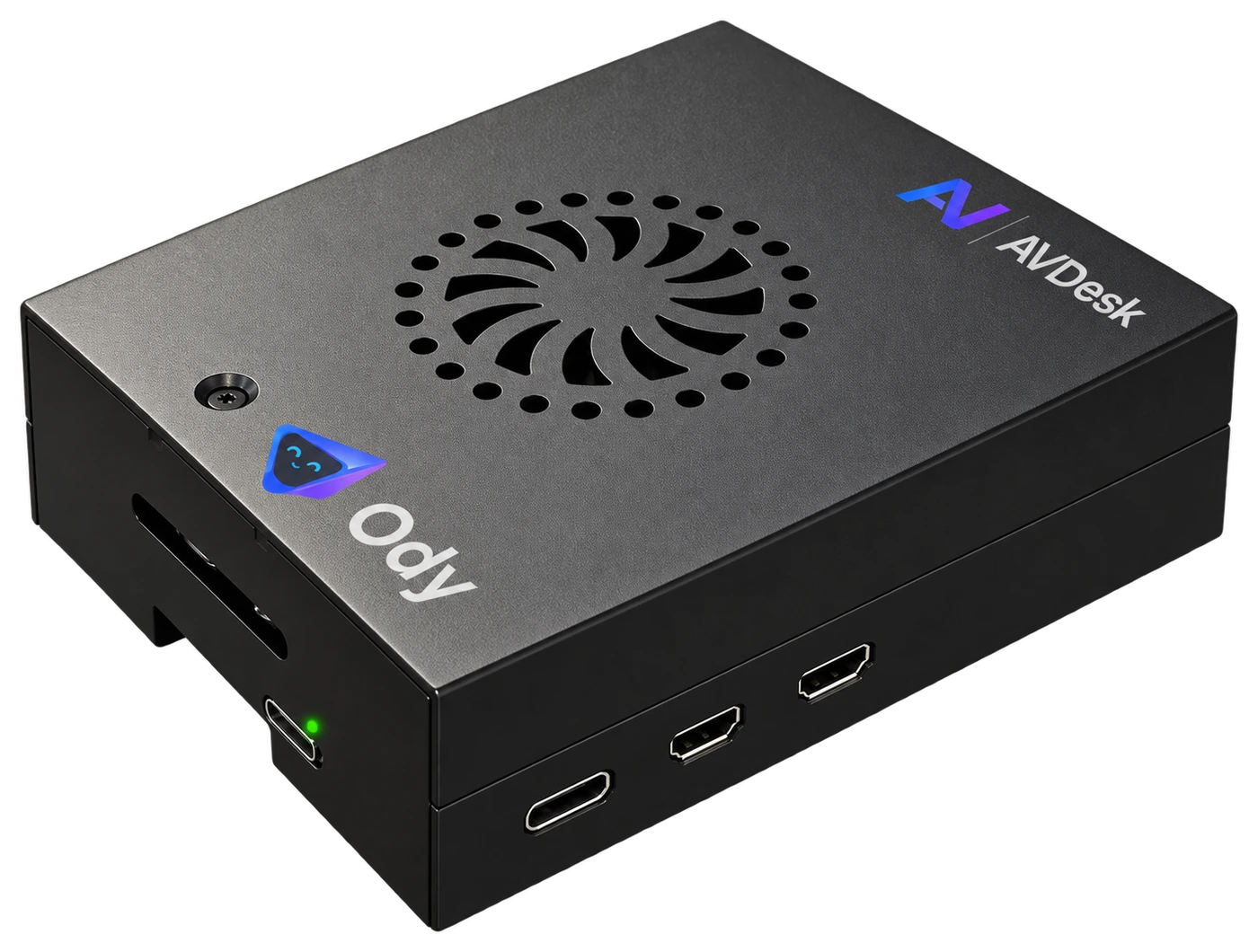
- On the LAN, the Ody box (integrator-installed, outbound-only encrypted tunnel) monitors and controls the AV equipment locally, including the gear no cloud can reach, over PJLink, Q-SYS QRC, Crestron, AMX NetLinx, ONVIF, SSH, SNMP and HTTP APIs.
- Above the clouds, the vendor platforms you already use federate in via SSO (SAML/OIDC), so their devices appear alongside everything else.
- Around all of it, the estate layer: alerts that raise tickets under SLA policies, remote control with every command audited, and an asset register where each device's history accrues regardless of which path detected the fault.
Side by side
| Vendor cloud | AVDesk | |
|---|---|---|
| Depth on its own brand | Excellent | Good (native protocol level) |
| Other brands' devices | Invisible | Monitored via Ody on the LAN |
| Non-cloud legacy gear | Invisible | Monitored |
| Switches / PoE / network | Invisible | Monitored via SNMP |
| One alert stream & ticket queue | No | Yes, with SLA clocks |
| Asset register, depreciation, lifecycle | No | Built in |
| Whole-estate uptime reporting | No | Yes |
| Best used as | Deep device tool | The estate platform above them |
The comparison isn't AVDesk or the vendor cloud. It's the estate with a platform layer versus the estate held together by browser tabs.
What this looks like in practice
Teams typically land here: vendor clouds stay for deep, brand-specific work (firmware campaigns, config pushes, vendor support cases). AVDesk becomes the place the estate is watched and run: the wakeup checks, the alert stream, the tickets, the asset history, the report that goes to leadership. The full architecture is in how to monitor Q-SYS, Crestron and third-party devices from one platform.
If you're weighing this exact question, the quickest resolution is a side-by-side on your own estate: book a demo of AVDesk AV Management Software and count what appears that the clouds can't see.