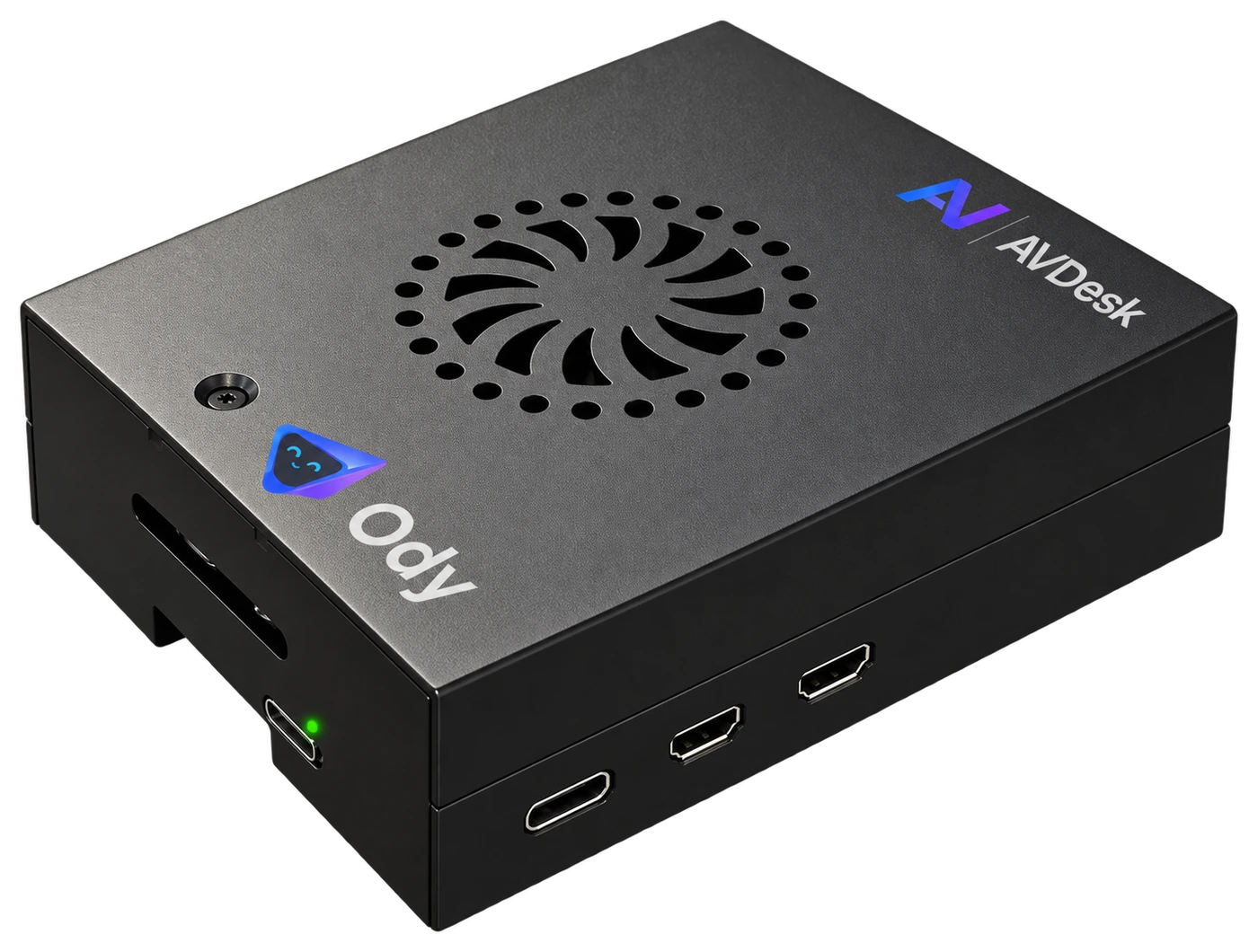

- Multi-site AV fails when each office is its own island. One platform with an Ody box per site makes the estate one system.
- Remote-first support changes the economics: most faults close from HQ, and the travel budget goes to work that needs hands.
- Role-based, per-site access lets local teams see their site while HQ sees the whole estate.
- Model-level standardisation data and estate-wide reporting are only possible when every site lives in one register.
The moment an AV team inherits its second, fifth, tenth site, the job quietly changes species. It's no longer "keep the rooms working". It's logistics: who can see what's broken in Perth, who has rights to fix what in Brisbane, whether the Melbourne fit-out bought the same displays as Sydney, and why the travel budget is gone by March.
The estates that run smoothly at scale all converge on the same playbook.
1. One platform, one Ody per site
The foundational move: every site gets its own on-site monitoring box (in AVDesk, an Ody, installed and commissioned by an accredited integrator), managing that site's AV equipment on the local network and dialling home over an outbound-only encrypted tunnel. No inter-site VPN mesh, no inbound firewall ports at any office, and network teams at each site sign off once.
Every site then lands in one platform, structured site → building → level → room, and "how's the estate" becomes one screen instead of a ring-around.
2. Support becomes remote-first, travel becomes deliberate
Multi-site economics are travel economics. When monitoring detects the fault and remote control can act on it (power, preset recall, reboot over the device's own protocol, every command audited), the majority of tickets close from HQ in minutes. The support desk runs one queue across all sites with SLA clocks per priority, and physical visits become what they should be: scheduled, batched runs for work that genuinely needs hands, not day-trips to press a power button.
Wakeup checks carry extra weight at scale: every critical room at every site, verified before each site's morning, without anyone being awake for it.
3. Access that matches the org chart
Central visibility must not mean central bottleneck. Per-site, role-based permissions let each location's people work their own patch (the facilities coordinator who can raise and work tickets for their building, the regional technician with asset-edit rights across their state, granular grants as fine as "add assets" or "upload photos") while the central team keeps the estate view and the settings. Users pinned to sites see their sites; nobody wades through nine cities of noise to find their own boardroom.
4. Standardisation you can actually enforce
Every multi-site estate says it standardises; the register says otherwise. When all sites share one asset register with a shared make/model catalogue, standardisation becomes measurable: which models are deployed where, which site's fit-out drifted, and, because end-of-sale and end-of-support dates live on the model, which "standard" is quietly going extinct before the next office opens. That's the data procurement needs before signing the next fit-out, not after.
5. Reporting that rolls up and drills down
Leadership wants one number per site; the AV manager needs the room behind the number. Estate reporting should do both: uptime and health by site, SLA performance by team, fault hotspots by room, refresh exposure by financial year across the whole footprint. One register plus one alert history is what makes those reports one click instead of one week.
The single-site question is "is the boardroom working?" The multi-site question is "which of my 400 rooms won't be, next week?" Only an estate-level platform can answer it.
Scaling the model
The playbook is deliberately repeatable: new site → integrator commissions an Ody → discovery populates the register → local team gets scoped access → the site joins the queue, the reports and the refresh forecast. Room-based licensing keeps the commercial side linear too: priced per room, unlimited assets within each, quoted for the estate. And where a growing footprint outruns a small AV team, AVDesk Managed Support can watch the monitoring, work the tickets and meet the SLAs across every site.
Sector-specific versions of this playbook, for councils, health services, schools, venues and more, are in who needs AV management software.
AVDesk AV Management Software was built for exactly this shape of problem. See the enterprise AV management overview, or book a demo with your site list in hand.