
- AV management software is one platform for the whole AV estate: inventory, monitoring, remote control, support tickets, maintenance and reporting, organised by site and room.
- It differs from IT service management and from vendor clouds: ITSM doesn't know AV devices, and each vendor cloud only knows its own brand.
- The core modules are an asset register, monitoring with remote control, a help desk with SLAs, maintenance and reporting; team tools such as rostering and tasks come on top.
- You need it once the AV estate outgrows one person's memory: many rooms or sites, mixed brands, or users who find faults before the team does.
AV management software is a platform for running an organisation's audio visual estate: every room, every device and every job done on them, in one place. It keeps the inventory, watches equipment health, lets technicians fix faults remotely, runs the help desk and maintenance, and reports on how the estate is performing. It is also called an AV management platform or AV system management software; the idea is the same.
If your organisation has more than a handful of rooms with displays, cameras, microphones and control systems, someone is already doing this work, usually with a spreadsheet, a few vendor portals, a shared inbox and memory. AV management software replaces that patchwork with one system of record.
AV management software, defined
A useful definition has three parts. AV management software:
- Knows the estate: which sites, buildings, rooms and devices exist, what each device is, and its status, warranty and history.
- Acts on the estate: checks health continuously, raises alerts and sends commands to fix faults remotely.
- Runs the work around the estate: tickets, SLAs, maintenance, people and reporting.
Tools that do only the first part are asset registers. Tools that do only the second are monitoring tools or vendor clouds. Tools that do only the third are help desks. AV management software joins the three, so an alert, the ticket it raises, the device it concerns and the technician who fixes it are one connected record.
What AV management software does: the core modules
- Asset register. Every device, organised by site and room, with make, model, serial, cost, depreciation, warranty and end-of-life dates, QR labels and a change trail. See AV asset tracking and register.
- Monitoring. Continuous health checks across brands, raising alerts before users notice, including wakeup checks on critical rooms before the day starts. See remote AV monitoring.
- Remote control. Power, input, mute, preset recall and reboot from a desk, with every command logged.
- Help desk and SLAs. Faults reported by users, raised by monitoring or logged by staff, all tracked as tickets against the room and device with response and resolution clocks. See AV help desk software.
- Maintenance. Scheduled and ad-hoc maintenance on a calendar, closed against the asset so the history builds up.
- Reporting. Uptime by site and room, SLA performance, estate health and lifecycle forecasts, in a form leadership will read.
- Team operations. For teams with technicians to coordinate: rostering, tasks and a site wiki keyed to the same rooms and devices.
How it differs from ITSM, vendor clouds and control systems
| Tool | What it knows well | What it misses about AV |
|---|---|---|
| IT service management (ITSM) | Users, IT assets, generic tickets, change control | Rooms, device health, AV protocols, remote control of AV gear |
| Vendor clouds | Their own brand's devices, in depth | Every other brand in the room, and the tickets and register around them |
| Room control systems | How to run one room's equipment | The estate view, history and support work across rooms |
| Network monitoring | Whether an IP address answers | What the device is, what its state means and who should fix it |
| AV management software | Rooms, devices across brands, alerts, tickets and history together | Designed to sit alongside the tools above, not replace them |
A common question is whether AV management software is the same as AV control software. It isn't. Control software (the programming in a Crestron, AMX or Q-SYS system) makes a room work when someone presses a button. Management software sits above every room and every brand and makes the estate work: it knows the room exists, whether it is healthy and what happened to it last week.
Who uses AV management software
- AV and workplace technology teams in corporates, universities, government, health and venues, who run the estate day to day.
- IT and facilities teams who share responsibility for rooms and need a scoped view of their part.
- AV integrators and managed service providers who support many client estates and need one queue across them (see managed AV services).
- Leadership and finance, who need uptime, SLA and refresh numbers they can trust.
Sector by sector the rooms and priorities differ; the guide to who needs AV management software walks through corporates, universities, councils, schools, health, venues and more.
Signs you've outgrown spreadsheets and vendor portals
- Users find faults before your team does, usually at the start of a meeting.
- Nobody can say with confidence how many displays, projectors or cameras you own, or where they are.
- You log in to three or more vendor portals to check on rooms.
- Warranty expiries and end-of-support dates arrive as surprises.
- Tickets live in an inbox, and nobody can tell you the average time to fix.
- Refresh budgets are argued from anecdotes rather than service history.
Two or more of those is the usual tipping point. Spreadsheets vs AV management software goes deeper.
What to look for when choosing
Platforms differ most on three things: whether they can reach equipment with no cloud account, what they ask of your network, and whether they run the support work or just record it. The full checklist is in how to choose AV management software: 12 questions to ask, and your IT team's questions are in security questions to ask before choosing AV software.
AVDesk AV Management Software
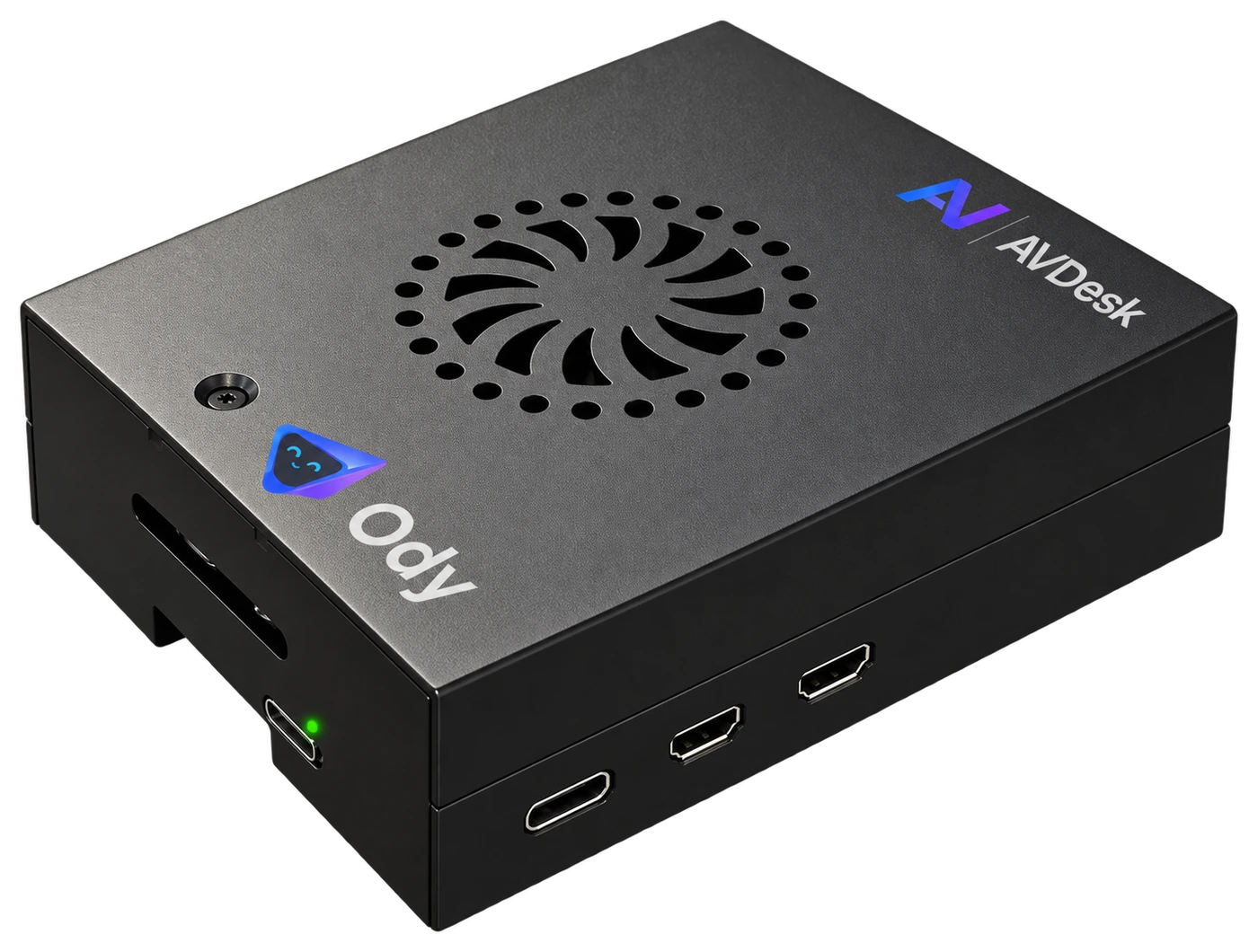
AVDesk is AV management software built in Sydney and hosted in Australia. A compact on-site box called Ody manages the AV equipment at each site and connects outbound to the cloud; vendor clouds federate in via SSO; and the asset register, monitoring, remote control, help desk, maintenance, rostering and reporting share one set of rooms and devices. It is priced per room and quoted for your estate. See AV management software for the product view, or book a demo.
Why AV teams move to AVDesk
- Gear with no cloud account, coveredOne Ody per site reaches the equipment on the local network, so older and cloud-less devices are monitored and controlled alongside the rest.
- Every brand, one screenQ-SYS, Crestron, AMX, PJLink displays and projectors, cameras and network gear in one estate view, with vendor clouds federated in via SSO.
- Nothing opened on your firewallOdy connects outbound over an encrypted tunnel. No inbound ports, no agents installed on devices, and an audit trail of every command.
- Priced per roomEvery room gets the full platform, with no per-device, per-seat or per-login charges. Add a room and it is a line on the bill.
- Australian, end to endBuilt in Sydney and hosted in Australia, with a Sydney team you can call on 1300 885 241.
- Run it your waySelf-managed by your own AV or IT team, or with AVDesk Managed Support watching the monitoring and working the tickets for you.
Moving to AVDesk
- A short call. We learn your sites, rooms and the systems you run, then scope a plan and a quote.
- Ody goes in. Contact AVDesk and we pass your details to a Registered AVDesk Integrator, who installs and commissions Ody at each site. Ody finds the AV devices for you; nothing changes on the gear.
- Prove it on one site. Monitoring, control and tickets go live on a pilot site so your team feels the difference first.
- Roll out. Every site joins the same platform, and you start reporting real uptime and SLA performance.