
- Judge coverage first: an on-site component is the only way to see gear that has no vendor cloud.
- Demand outbound-only security, audited remote actions and AU data residency.
- Depth test: depreciation, lifecycle dates and a change trail separate a register from a list.
- Prefer per-room pricing: per-device pricing punishes a complete register.
Choosing an AV management platform is a decision you'll live with for years. The register, the ticket history and the team's habits all accrete inside it. Demos are polished by design, so go in with questions that expose the architecture underneath. Here are the twelve we'd ask.
Coverage: can it actually see your estate?
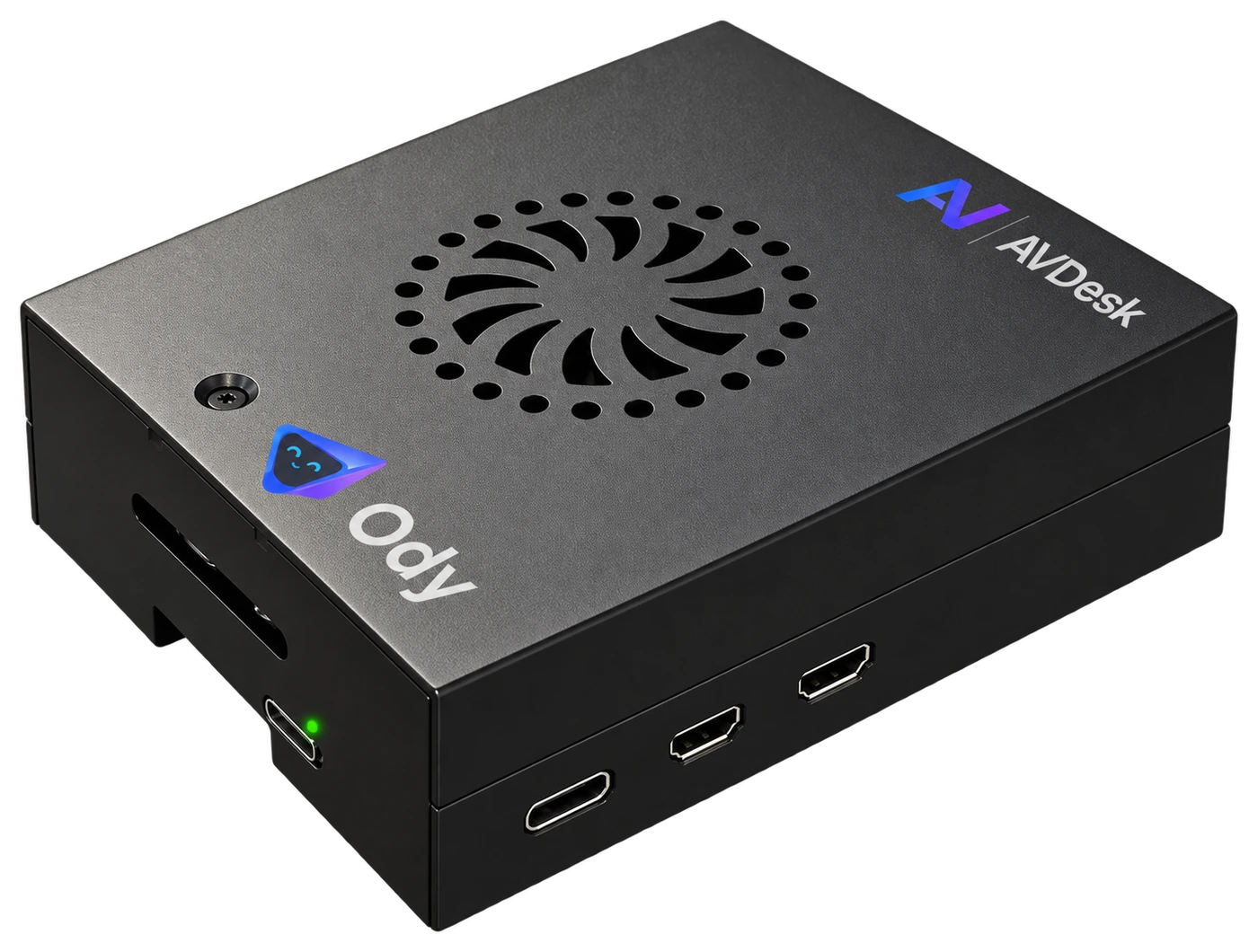
1. How does it reach devices that have no cloud? Most AV gear (projectors, amplifiers, switchers, legacy processors) has no vendor cloud account. If the answer is "it integrates with the vendor clouds", most of your estate will be invisible. Look for an on-site component that monitors the AV equipment on the LAN directly; in AVDesk that's the Ody box, installed by an accredited integrator.
2. Is it brand-agnostic? Mixed estates are the norm. Confirm protocol coverage (PJLink, Q-SYS QRC, Crestron, AMX NetLinx, ONVIF, SSH, SNMP, HTTP) rather than a list of preferred brands.
3. What happens to the vendor clouds you already use? Microsoft Teams Rooms, Webex Control Hub, Zoom Rooms, XiO Cloud, Q-SYS Reflect, Logitech Sync, Poly Lens — the right answer is that they federate in via SSO and sit beside the on-premises gear, not that you abandon them.
Security: what does it ask of your network?
4. Which firewall ports must open inbound? The best answer is none: an outbound-only encrypted tunnel from the site, with no equipment exposed to the internet and nothing installed on the devices themselves.
5. Is every remote action auditable? If someone reboots a courtroom DSP mid-session, you need to know who and when. Command logging should be built in, not a roadmap item.
6. Where does the data live? For Australian organisations, AU data residency and a local team matter: for latency, for procurement and for the 4pm phone call. AVDesk is Sydney-built with AU-hosted data.
The full list a security reviewer will work through is in security questions to ask before choosing AV software.
Depth: is it a register or a real asset system?
7. What does an asset record actually hold? Look past tag and serial: purchase cost, straight-line depreciation, written-down value, warranty and end-of-life dates, photos, consumables and a field-level change trail. That's the difference between a list and an asset system finance will accept.
8. How does the register stay accurate? The honest answer involves workflow, not willpower: network discovery feeding a validation queue, QR labels for in-room updates, and scan-based stocktakes.
Workflow: does it run the work, or just record it?
9. How do faults become tickets? Three paths should all exist: monitoring alerts raising tickets automatically, users reporting via room QR codes, and email into the queue. Then SLA policies with response and resolution clocks per priority. See how AVDesk's support desk handles it.
10. Can it schedule preventative maintenance? Recurring, room-based schedules that produce real tickets. Otherwise, preventative work stays theoretical.
Commercials: the model you'll live with
11. What's the pricing unit? Per-device pricing punishes you for having a complete register. The incentive runs backwards. Per-room pricing (AVDesk's model: one room licence, unlimited assets in it, quoted for your estate) means the register can be exhaustive at no marginal cost.
12. Who installs, and who supports? Ask how commissioning works (AVDesk uses accredited integrators to install and commission each site) and whether you can choose between running it self-managed or having the vendor's team watch the monitoring and work the tickets under managed support.
Score it against your estate, not the demo
Take your three most problematic rooms and your current spreadsheet into every evaluation, and make the vendor show those, not the showcase floor. The platform that handles your worst rooms gracefully is the one that will handle the other two hundred.
Happy to be scored against that standard: book an AVDesk demo and bring the hard rooms.