
- Volunteer AV fails at handover: the knowledge lives in one person's head. Put it on the equipment and in the platform instead.
- A QR label on every device opens its record, its history and its notes, so the new volunteer standing at the rack knows what they're looking at.
- Sunday can't be rescheduled; wakeup checks and remote preset recall mean the service starts on time even when the expert isn't there.
- A register with value, warranty and location satisfies the treasurer, the insurer and the grant application from the same record.
Volunteer AV is knowledge in people's heads
The main auditorium has a digital mixing console, a DSP, wireless microphones, a projector or LED wall, cameras for the livestream and a streaming encoder. The hall has its own smaller system. The youth room, the chapel and the meeting rooms each have a display and a soundbar. It's a genuine AV estate, and it's run by a rotating team of volunteers: the one who set it up, the one who's good with the console, and whoever is free this week.
That works until the person who set it up moves interstate. Then nobody knows why the encoder needs to be powered on second, which preset is the "normal" one, or where the spare microphone batteries are kept. AV management for a community organisation is mostly about making sure the knowledge outlives the volunteer.
Put the knowledge on the equipment
The single most useful thing a volunteer team can do is label every device with a QR code that opens its record in AVDesk. A new volunteer standing in front of the rack scans the sticker and sees what it is, what it's connected to, the notes the last person left ("power this on after the DSP, never before"), the history of faults and fixes, and any open ticket. The record can be updated on the spot, so the knowledge accrues where the equipment is rather than in one person's memory.
Alongside the labels, each site has its own documentation wiki in AVDesk: how the service is run, the standard presets, photos of the rack, the "what to do when" list, with attachments and pictures, searchable from a phone. It's the handover document that writes itself over time.
Sunday can't be rescheduled
An office can push a meeting to Tuesday. A service, a match day or a community event happens when it happens. That's where monitoring earns its place even in a small estate:
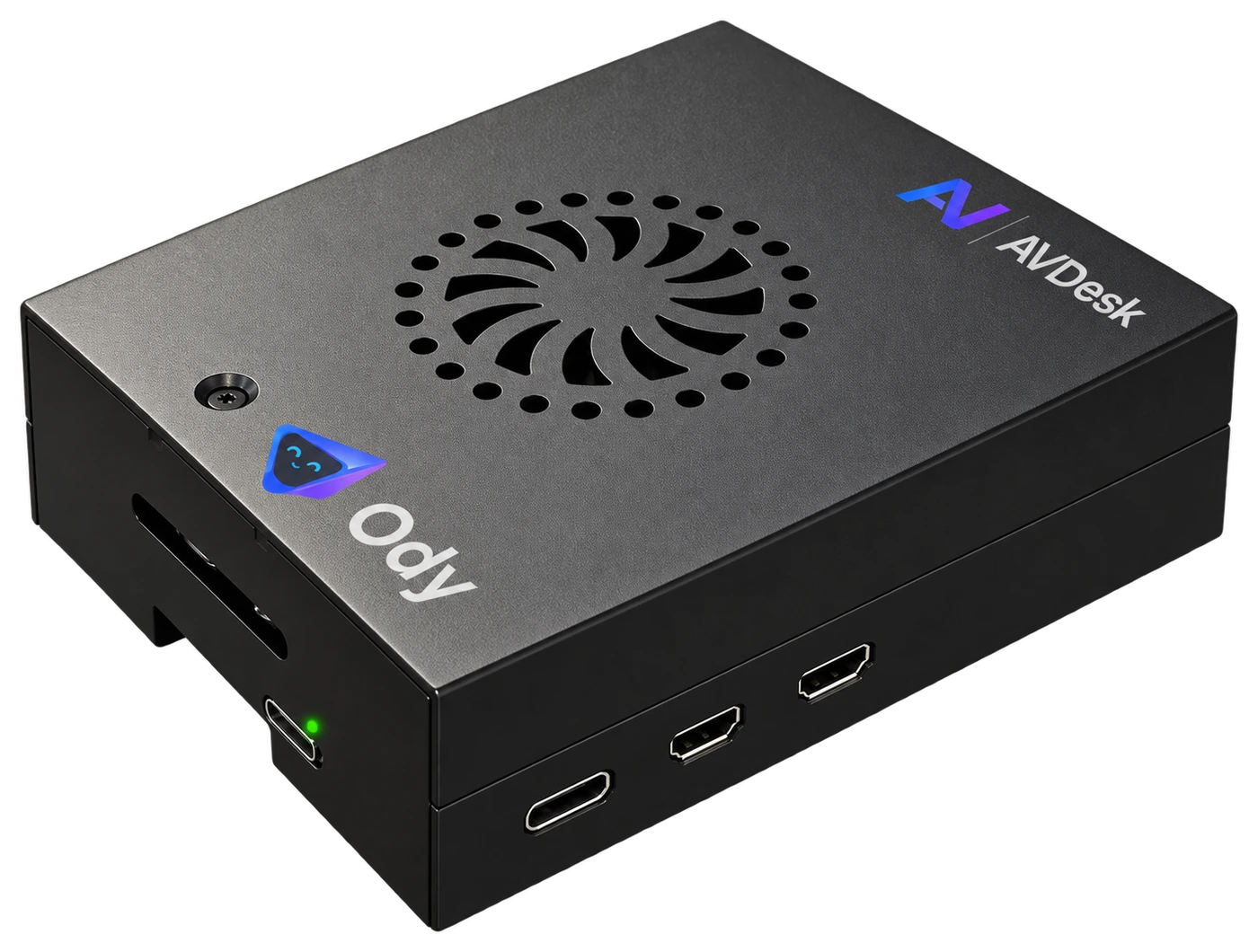
- Wakeup checks before the service. The on-site Ody box verifies the auditorium's projector, DSP, encoder and processor early in the morning, and raises a ticket if anything doesn't respond.
- Presets and reboots from a phone. Recall the standard preset, switch the projector on, reboot the encoder that locked up, from home, before the volunteer team arrives, with every command logged.
- Someone else can watch it. Organisations without a technical volunteer can have their integrator or AVDesk Managed Support watch the monitoring and handle the tickets, so the Saturday-night alert is dealt with by a professional.
Fault reporting for anyone in the building
A QR code on the wall of each room lets anyone (the volunteer, the hall hirer, the youth leader) report a fault for that exact room in seconds, with no app and no login. The ticket lands in the support desk linked to the room and its equipment. Faults stop being mentioned in passing on Sunday and forgotten by Wednesday.
The register for the treasurer, the insurer and the grant
Community organisations get asked for asset registers constantly: by the insurer at renewal, by the auditor, by the grant body that funded the LED wall, by the committee when someone proposes a new console. The AVDesk register answers all of them from one record:
| Who's asking | The answer on the record |
|---|---|
| The treasurer | Purchase cost, straight-line depreciation and written-down value per asset; what the estate is worth in total. |
| The insurer | What's installed, in which room, at what value, with serials and photos. |
| The grant body | The funded equipment, where it is, and that it's still in service. |
| The committee | Warranty and end-of-support dates per model, so "the projector is old" becomes a dated refresh plan. |
| Whoever's on this Sunday | Where the spare batteries, lamps and cables are, because consumables are tracked with the equipment they serve. |
Multi-campus churches and organisations with several halls
A church with three campuses or a community organisation with several halls is a multi-site estate, and AVDesk treats it as one: an Ody at each site you want monitored, one register structured site → building → room, permissions so each campus team works its own rooms, and one support queue. The volunteer who helps at two campuses has one login.
Keep it simple
A community organisation doesn't need every feature on day one. The minimum that changes everything: the equipment in the register with its location and value, a QR label on each device, a QR code on each room's wall, and the wiki started with the three things the next volunteer must know. Monitoring comes when the organisation decides Sunday is worth a wakeup check.
The volunteer who knew everything has moved on. The rack still knows. That's the goal.
Getting started
An accredited AVDesk integrator commissions the site, imports whatever list exists, and prints the labels. AVDesk is priced per room and quoted for your rooms, which for most community organisations is a small number. Book a demo, or ask your integrator about AVDesk.