
- Small-business AV fails for lack of an owner, not lack of equipment; the fix is a platform someone else watches.
- AVDesk Managed Support, delivered through your integrator, means faults are found by monitoring and usually fixed remotely before the 9am meeting.
- Staff report the crackly microphone by scanning a QR code on the wall; no app, no ticket system to learn.
- A simple register with cost, warranty and depreciation answers the accountant, the insurer and the landlord at lease end.
The small-business AV problem
Every growing business reaches the point where meeting rooms matter. Client pitches happen in the boardroom, the fortnightly all-hands runs on the big screen, and half the team dials in from somewhere else. The rooms get fitted out properly, by a good integrator, with Teams Rooms or Zoom Rooms kit, a decent display, a camera and a soundbar or ceiling microphones.
Then the integrator leaves, and the rooms belong to nobody. IT is one person or an outsourced provider who looks after laptops. The office manager knows which room "gets weird". When the boardroom display refuses to wake at 8:55 with a client in reception, the fix is whoever is nearest and a power cable. The equipment isn't the problem. Ownership is.
What "managed" looks like when there's no AV team
AVDesk was designed so that a business without an AV team gets the same operation a large one has, delivered by someone else:
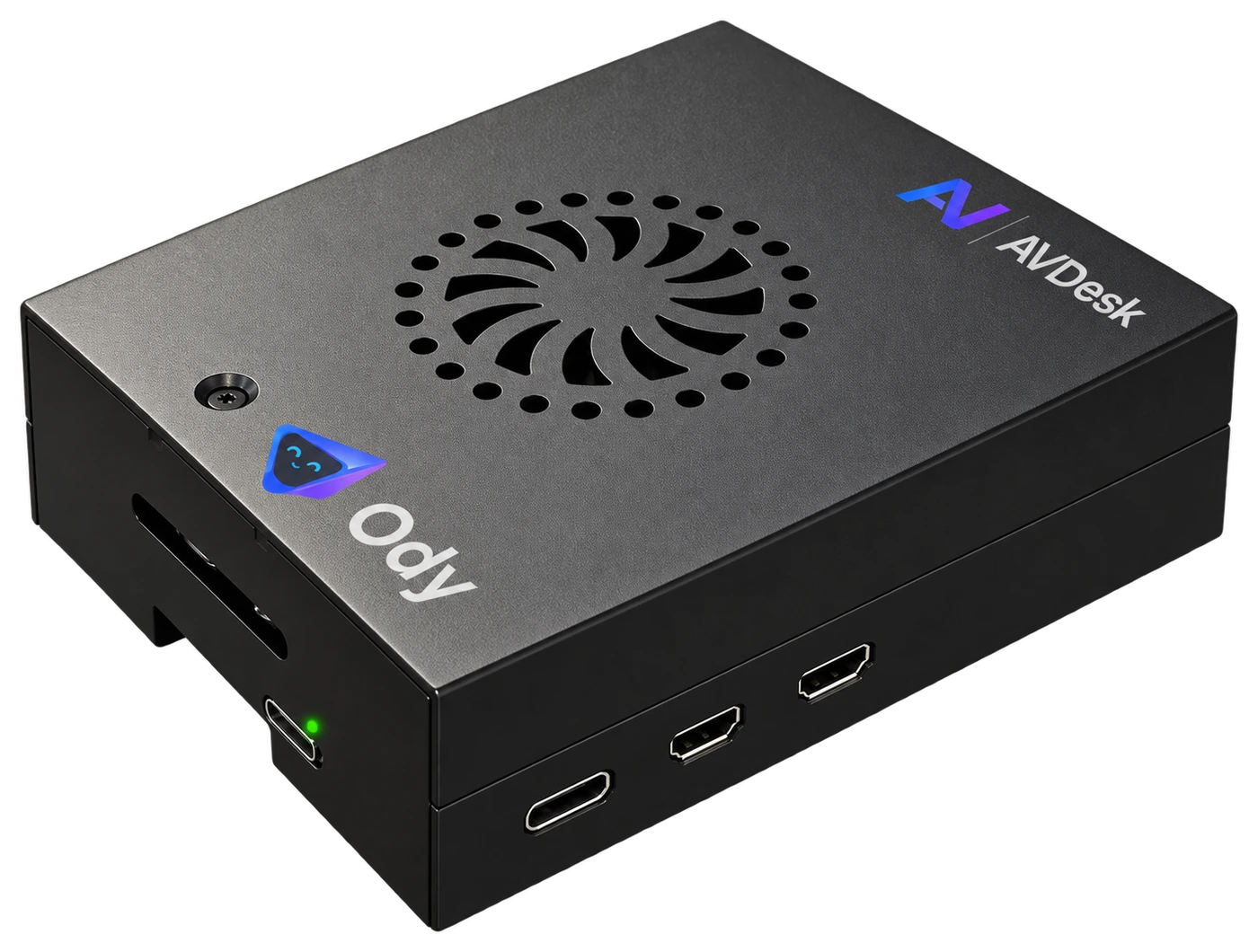
- Your integrator installs an Ody. The small on-site Ody box sits on your network, finds the rooms' AV equipment and checks it around the clock, connecting outbound over an encrypted tunnel. No firewall changes, nothing installed on the devices.
- Someone watches the monitoring. Under AVDesk Managed Support, alerts go to the AVDesk team or your integrator, not your inbox. The frozen room is noticed at 6am and rebooted remotely before anyone arrives.
- Faults become tickets with clocks. Everything is tracked in the support desk under an SLA, so "we called them last week" becomes a ticket with a status you can see.
- Site visits become rare and planned. Most day-to-day faults (the wrong input, the stuck processor, the muted DSP) close remotely. When hands are needed, the visit is scheduled with the fault already diagnosed.
The 8:55 problem
The fault that damages a small business isn't the big one, it's the small one at the wrong moment: the boardroom that won't wake with a prospect in reception. AVDesk runs wakeup checks against rooms with a hard start time, verifying the display, the room system and the audio before the day begins. A fault caught at 6:10 and fixed by 6:15 never happened as far as the client is concerned.
Fault reporting your staff will actually use
Nobody in a small business wants to learn a ticketing system. Put a QR code on the wall of each room instead: a staff member scans it, types "microphone crackles on calls", and submits. The ticket lands with the room and its equipment already attached, and the reporter gets a link to see it handled. The number of small faults you hear about goes up, which is exactly what you want, because small faults fixed early don't become the 8:55 problem.
What you actually own
Few small businesses could list their AV equipment, let alone its value. The AVDesk register is filled mostly by discovery, with the integrator confirming what Ody finds, and it answers questions that otherwise take an afternoon:
| Who's asking | The question | The answer on the record |
|---|---|---|
| Your accountant | What did we buy, when, and what's it worth now? | Purchase cost, straight-line depreciation, written-down value. |
| Your insurer | What's installed, where, at what value? | Room-level location, serials, photos, current value. |
| Your landlord at lease end | What's yours and what stays? | Every asset by room with ownership noted, so the make-good conversation has a list. |
| You, when it breaks | Is this still under warranty? | Warranty expiry on the record, with a heads-up before it lapses. |
Grow without re-tooling
AVDesk is priced per room, with unlimited equipment in each. Six rooms today, eleven after the fit-out, a second office next year: each room is added, and the second office gets its own Ody. Nothing about the way the estate is run changes as it grows, which is the point of starting properly with six rooms rather than starting again with sixty.
A small business shouldn't need an AV manager to have managed AV. It needs an integrator, an Ody, and someone watching the screen.
How to start
Ask your integrator about AVDesk, or book a demo with us and we'll bring an accredited integrator to the conversation. Commissioning a small office is a day's work; from then on the rooms are watched, the faults are tracked, and the boardroom wakes up before you do.