
- Council AV is scattered across dozens of small sites with one or two people responsible for it, so the platform has to see every site from one screen.
- The chamber livestream is the one room that cannot fail; wakeup checks before each meeting and audited remote control make it dependable.
- Hirers and residents report faults by scanning a QR code on the wall, with no app or login, so problems surface while they're still cheap.
- One register with cost, depreciation, warranty, Test & Tag and an audit trail satisfies finance, insurance and the auditors from the same record.
Why council AV is harder than it looks
Corporate AV teams manage floors of near-identical meeting rooms. Councils manage variety: a chamber with a broadcast-grade system, a dozen library branches with a program room each, community halls hired out to yoga classes and wedding receptions, a leisure centre with a public-address system and displays, a depot with a training room, and the customer service counter with a queue screen. Every one of those was installed at a different time, by a different contractor, to a different standard.
Responsibility for that estate usually lands on one AV or IT person, or on facilities, or on an integrator with a maintenance contract. Whoever it is, they can't be in twenty buildings at once. The only way to run an estate like that well is to make every site visible from one place, and to make it easy for the people already in the building to tell you when something is wrong.
The chamber that can't fail
Council meetings are livestreamed, recorded and minuted. When the chamber system fails, the failure is public, and it can delay decisions with statutory timeframes attached. It deserves the strongest tools in the kit:
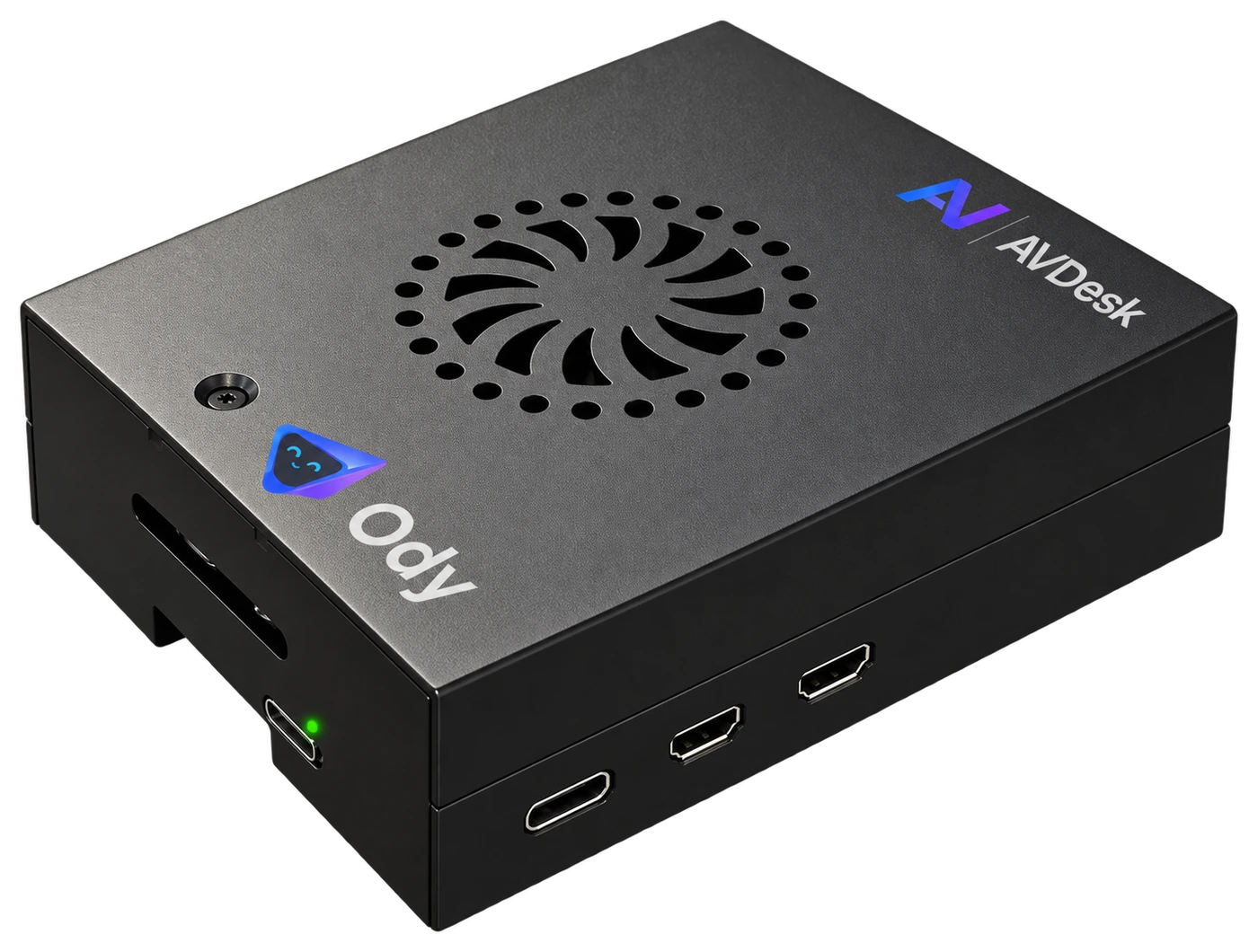
- Wakeup checks before every meeting. The on-site Ody box verifies the chamber's cameras, microphones, DSP, displays and streaming encoder well before the mayor arrives, and raises a ticket the moment anything is off.
- Remote fixes with a paper trail. Power, preset recall and a hard reboot of a frozen processor are all issued from a desk over an outbound-only encrypted tunnel, and every command is logged with who sent it and when. That audit trail matters in a public institution.
- History that argues for the upgrade. Every alert and ticket accrues against the chamber's assets. When the encoder has locked up four times this quarter, the case for replacing it writes itself.
Community halls and hireable rooms
The most common council AV fault isn't in the chamber. It's the projector in the community hall that a hirer couldn't get working on Saturday night, reported on Monday by email, if at all. AVDesk puts a QR code on the wall of every hireable space: the hirer scans it with their phone, gets a fault form for that exact room, types a sentence and submits. A ticket lands in the support desk already linked to the room and its equipment, with a public link so the hirer can see it being handled.
No app, no login, no "which hall are you in" guesswork. Faults surface the same day instead of the next hire, and the pattern of faults per hall tells you which rooms need a rebuild rather than another call-out.
Libraries: the busiest AV in the council
Library branches are program venues, meeting-room providers, makerspaces and signage networks rolled into one, run by staff whose job is not AV. They deserve their own treatment, so we've written one: managing AV in public libraries. The short version is that branch staff report faults by QR, the program room is verified before the morning session, and every branch sits in the same register as the chamber.
An asset register the finance team and the auditors will accept
Councils account for their assets properly, which means the AV register can't be a spreadsheet in someone's drive. The AVDesk register carries what finance needs on the same record technicians use:
| Who needs it | What they ask | What the register answers |
|---|---|---|
| Finance | What is the estate worth? What falls off the books next year? | Purchase cost, straight-line depreciation and written-down value per asset, roll-ups per site and financial year. |
| Insurance | What's installed where, at what value? | Location down to the room, serials, photos and current value on every record. |
| WHS and compliance | Is the portable equipment tested and tagged? | Test & Tag records and due dates against each asset, with the next test date visible before it lapses. |
| Internal audit | Who changed this, and when? | A field-level activity trail on every asset, preserved even if the asset is later removed. |
| Procurement | Which models are going end-of-support? | Lifecycle dates on the model catalogue driving a refresh forecast bucketed by Australian financial year. |
Because AVDesk is priced per room with unlimited assets in each, there is no reason to leave the lectern, the hearing loop or the spare radio microphones out of the register. Complete registers are what make audit season boring.
Built for council procurement
- Australian-built, AU-hosted. AVDesk is developed in Sydney and hosted in Australia, which shortens the data-sovereignty questions in a council procurement.
- Nothing inbound, nothing installed on devices. Ody talks outbound over an encrypted tunnel; no firewall ports open, no agents on equipment, and the IT team signs off once.
- Per-site, role-based access. Library staff see their branch, the facilities team sees the halls, the AV lead sees the whole estate.
- Integrator-installed, your choice of support. An accredited integrator commissions each site. From there the council runs it self-managed, or chooses AVDesk Managed Support and our team watches the monitoring and works the tickets under SLA.
The chamber is verified before the meeting, the hall hirer reports the fault from the hall, and the auditor reads the same record the technician updated. That's what one platform does for a council.
Where councils usually start
Most councils pilot with two sites: the chamber, because it's the room leadership cares about, and one library branch, because it's the busiest. An Ody at each, the existing spreadsheet imported into the register, QR codes on the walls, and the support desk switched on. The rest of the estate joins site by site, each one taking a few days rather than a project.
Book a demo and bring your chamber and your most troublesome hall; we'll show you both running in one place.